White kitchens are the most popular kitchen colour choice in Australia. They have been for years. And every year, a wave of design articles appears predicting the end of the white kitchen, declaring that colour is back, that dark cabinetry is the future, that white is “over.”
Then the renovation numbers come in and white kitchens are still the most requested style. Again.
So which is it? Is a white kitchen a safe, timeless choice that will look good for decades? Or is it an overplayed default that lacks personality and will eventually date?
The answer depends on which version of “white kitchen” you are talking about, because they are not all the same.
The White Kitchen That Dates
There is a specific version of the white kitchen that will age poorly. It is the one that treats white as a trend rather than a foundation.
This is the kitchen where everything is white. White cabinetry, white benchtop, white splashback, white flooring, white walls. No contrast, no texture, no warmth. It looks striking in photos (especially with professional lighting and no actual cooking happening), but in real life, it feels clinical. Cold. Like a display kitchen that nobody lives in.
This version became popular because it photographs well on social media. Bright, clean, minimal. But kitchens are not photo studios. They are rooms where food gets cooked, kids do homework, and life happens. A kitchen with zero visual warmth or contrast can feel like an operating theatre after a few years.
The all-white, zero-contrast kitchen is the one most likely to feel dated within five to seven years, not because white goes out of style, but because the “everything matching” approach does.
The White Kitchen That Lasts
The version of a white kitchen that stands up over time is the one that uses white as the dominant colour but introduces contrast, texture, and warmth through other elements.
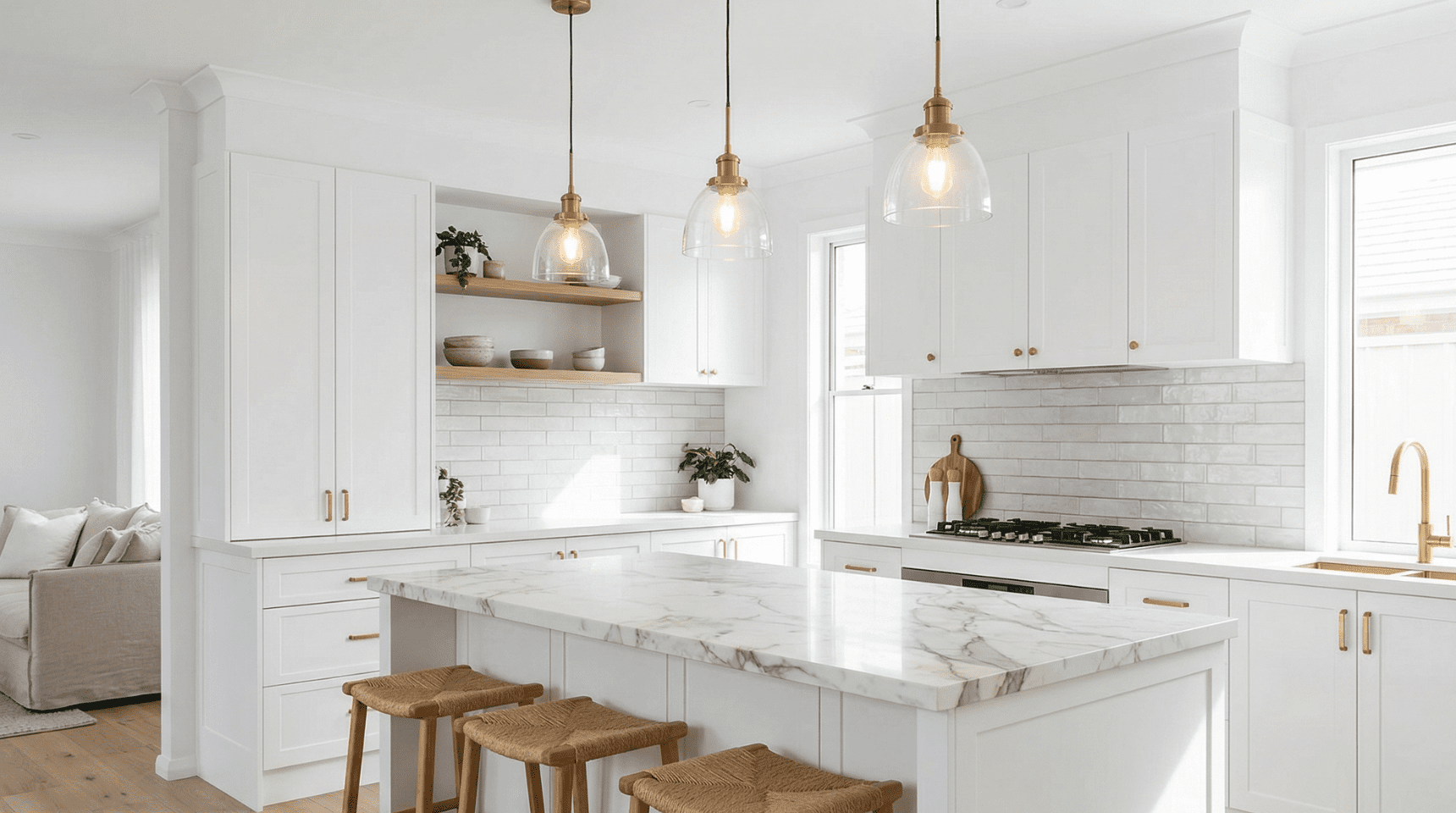
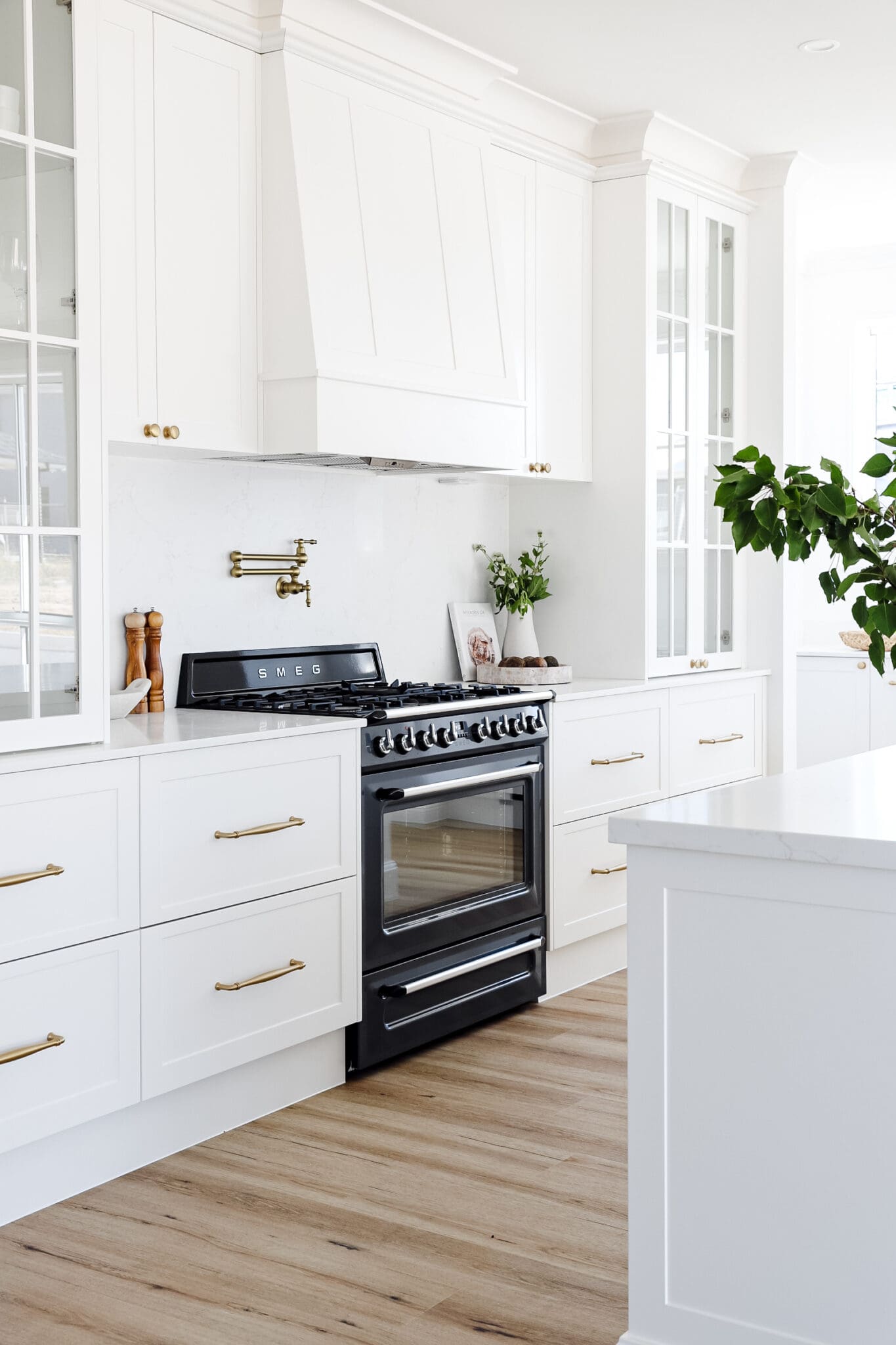
White cabinetry with a stone benchtop that has visible veining. A timber or darker-toned island bench paired with white perimeter cabinets. A textured splashback (subway tile, VJ panelling, or natural stone) instead of a flat white panel. Brushed brass or matte black hardware that creates visual punctuation against the white surface.
This is the white kitchen that has worked for decades in Australian homes, and it is the version that continues to sell well and appraise well at resale. The white is the canvas. The details are what give it character.
Our guide to designing an all-white kitchen covers how to introduce warmth and contrast without losing the clean, light feel that makes white kitchens appealing in the first place.
Why White Works in Open-Plan Homes
There is a practical reason white kitchens remain dominant in Sydney’s south-west, and it has nothing to do with trends. It has to do with light.
Most homes in the Macarthur region have open-plan kitchen, dining, and living areas. The kitchen is visible from every other space in the main living zone. White cabinetry reflects light, making the kitchen feel larger and brighter. In homes where the kitchen does not have a window directly above the bench (common in island-focused layouts), white surfaces compensate by bouncing whatever ambient light is available.
Dark cabinetry looks stunning in large kitchens with generous natural light, high ceilings, and dedicated task lighting. In a standard 2,400mm ceiling open-plan home, dark cabinets can make the kitchen feel smaller and heavier than it is.
This is not a rule. It is physics. Light colours reflect light. Dark colours absorb it. If your kitchen gets limited natural light, white (or light-toned) cabinetry will make the space feel more open. That functional benefit outlasts any trend cycle.
The Maintenance Reality
One genuine criticism of white kitchens is maintenance. White shows everything. Fingerprints, grease splatter, sauce stains, scuff marks from school bags dragged across the island. If you have young children, a white kitchen will need wiping down more often than a darker one.
But the degree of this problem depends heavily on the door finish.
Polyurethane cabinetry in a matte or satin finish is the easiest to maintain in white. The surface wipes clean with a damp cloth and does not show fingerprints the way a high-gloss finish does. Matte white is forgiving in a way that gloss white is not.
Thermolaminated white doors are more prone to showing marks and harder to clean without leaving streaks. Laminate white is easier to maintain but can yellow slightly over time with UV exposure, depending on the product.
If you choose white, choose the right finish for your household. A family with three kids under ten needs matte polyurethane, not high-gloss lacquer.
Resale Value: What Buyers Actually Want
Real estate agents will tell you that white kitchens sell homes. This is broadly true. White is a neutral that appeals to the widest range of buyers. It does not impose a personal taste on the viewer. A buyer can walk into a white kitchen and immediately picture their own style layered on top.
Dark or bold-coloured kitchens are polarising at resale. A deep navy kitchen is beautiful if the buyer loves navy. If they do not, they see a renovation project.
If resale is part of your thinking (even if you plan to stay for ten years, things change), a white kitchen with warm accents is the safest colour choice from a property value perspective. This is especially relevant in suburbs like Oran Park and Harrington Park where buyers tend toward family-friendly, move-in-ready homes.
The Alternatives Worth Considering
If you are drawn to white but worried about it being too safe, there are ways to introduce colour without committing the entire kitchen.
Two-Tone Cabinetry
White upper cabinets with a darker or coloured base. Or a white perimeter with a feature-coloured island. This gives you the lightness of white where it matters (eye-level and above) while adding personality at the base where it is less visually dominant.
Warm Whites and Off-Whites
Not all whites are the same. A warm white (with a slight cream or grey undertone) feels softer and less sterile than a bright, cool white. Warm whites suit Hamptons, coastal, and transitional kitchen styles and age more gracefully than stark whites.
White Cabinetry with Bold Benchtops
A white kitchen with a heavily veined dark stone benchtop creates drama without colour risk. The stone does the heavy lifting while the cabinetry stays neutral. This combination works particularly well in modern Hamptons and contemporary designs.
The Verdict
White kitchens are not a trend. They are a foundation. The version that uses white as one element in a layered, textured design will look good for fifteen years or more. The version that makes everything white with no contrast is the one that risks feeling flat after five.
The key is treating white as a starting point, not the entire palette. Add stone with character. Choose hardware that creates contrast. Introduce timber, texture, or a subtle accent colour. Do that, and your white kitchen becomes timeless rather than generic.
If you are planning a white kitchen and want to see how different whites, stones, and hardware options work together, book a free consultation or visit our Narellan showroom to compare materials in person.