If you have spent any time looking at kitchen inspiration on Instagram or Pinterest, you have seen Hamptons kitchens everywhere. White cabinetry, stone benchtops, shaker-profile doors, and a feeling that is both classic and warm. It is one of the most requested kitchen styles in Australia for good reason.
But there is more than one version of Hamptons, and the differences are not just cosmetic. A traditional Hamptons kitchen, a coastal Hamptons kitchen, and a modern Hamptons kitchen each have a distinct look, different material choices, and suit different types of homes.
Picking the wrong one is not the end of the world, but picking the right one means your kitchen feels like it belongs in your home rather than looking like it was copied from a magazine.
What Makes a Kitchen “Hamptons”
The Hamptons style originated from the luxury beach houses on Long Island, New York. It blends coastal lightness with classic elegance. In Australia, it has been adapted to suit our climate, lifestyle, and materials.
The common threads across all Hamptons kitchens are shaker-profile cabinet doors (or a variation of them), light colour palettes, natural stone or engineered stone benchtops, and a focus on symmetry and proportion. Hardware is typically visible (as opposed to handleless designs), and the overall feeling is warm, inviting, and timeless.
Beyond those shared features, the three Hamptons styles diverge.
Traditional Hamptons
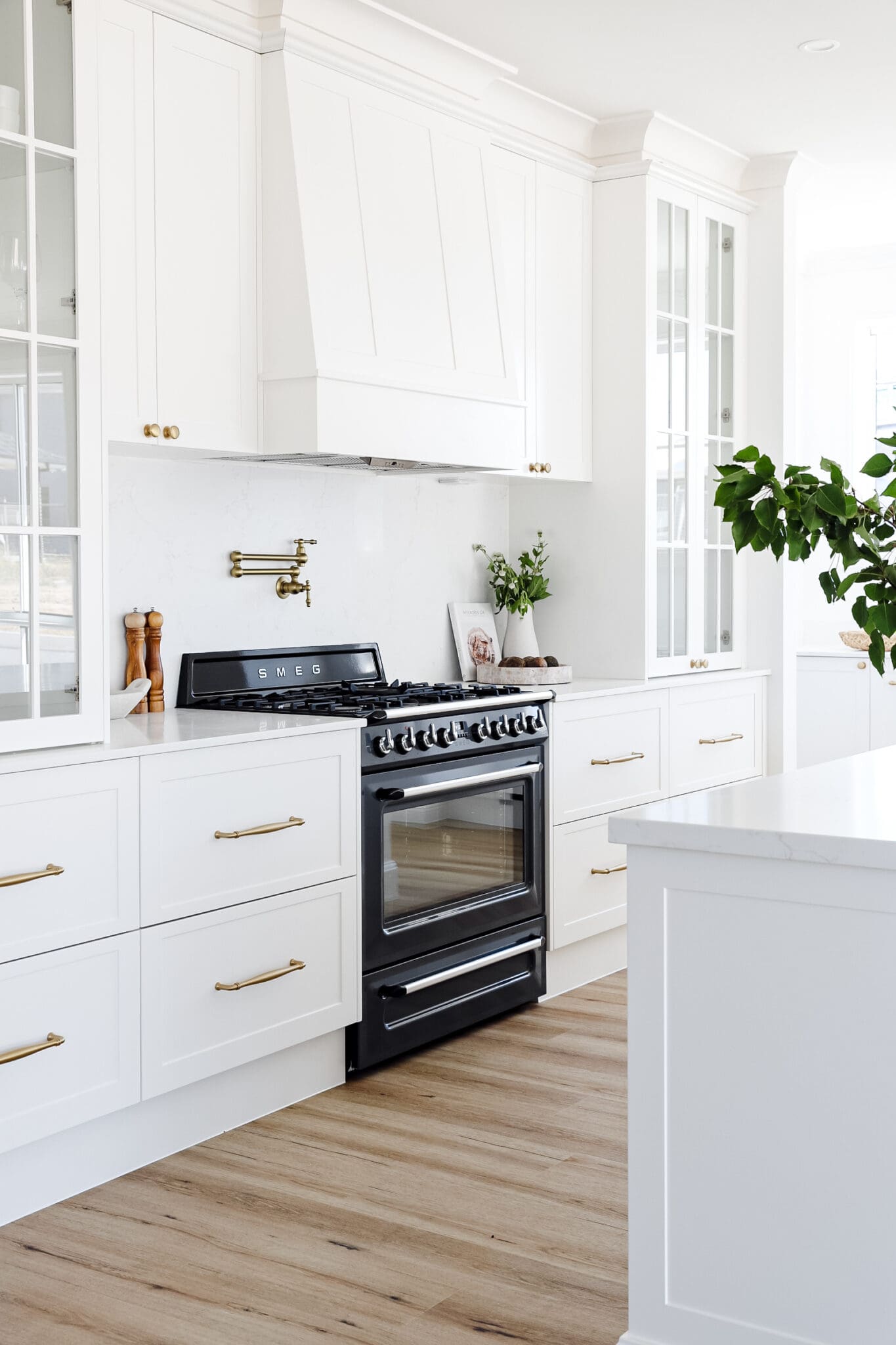
Traditional Hamptons is the most formal of the three. It leans into classic details: raised-panel or shaker doors with bevelled edges, ornate handles in brushed nickel or pewter, glass-front upper cabinets, and crown moulding along the top of wall cabinetry.
The colour palette centres on crisp white cabinetry with grey or charcoal accents. Benchtops are typically a white or grey engineered stone with subtle veining, or natural marble if the budget allows. The splashback is often subway tile in a classic brick pattern.
Traditional Hamptons works best in homes with higher ceilings and separate or semi-open kitchen spaces. The detailed mouldings and proportional design elements need vertical space to look balanced. In a low-ceiling open-plan home, the ornamentation can feel heavy.
Best Suited For
Established homes with higher ceilings. Homeowners who want a classic, elegant kitchen that feels like a permanent design choice rather than a passing trend. Homes in the Southern Highlands or heritage-influenced areas where traditional design fits the streetscape.
Coastal Hamptons
Coastal Hamptons takes the bones of the Hamptons style and strips back the formality. The mood shifts from elegant to relaxed. Think beach house, not manor house.
Cabinet doors are still shaker-profile, but simpler. Less ornamentation, fewer mouldings, cleaner lines. The colour palette softens: whites are warmer (think linen and chalk rather than bright white), and you will see more natural timber, rattan, and woven textures introduced through open shelving, pendant lighting, or bar stools.
Benchtops lean toward lighter stones or stones with softer patterning. Splashbacks might be a VJ (tongue and groove) panelling instead of tile, which reinforces the coastal feel. Hardware shifts to brass, brushed gold, or matte black.
The biggest difference is the feeling. A traditional Hamptons kitchen feels curated and refined. A coastal Hamptons kitchen feels like you could walk in from the beach and start cooking.
Best Suited For
Open-plan family homes with a connection to outdoor living. Homes across the Macarthur region, the South Coast, and anywhere in NSW where the lifestyle is relaxed and family-oriented. This style works well in the single-storey and double-storey homes found in suburbs like Harrington Park, Camden, and Gregory Hills.
Modern Hamptons
Modern Hamptons is the newest evolution. It keeps the warmth and symmetry of the Hamptons style but replaces the traditional details with contemporary ones.
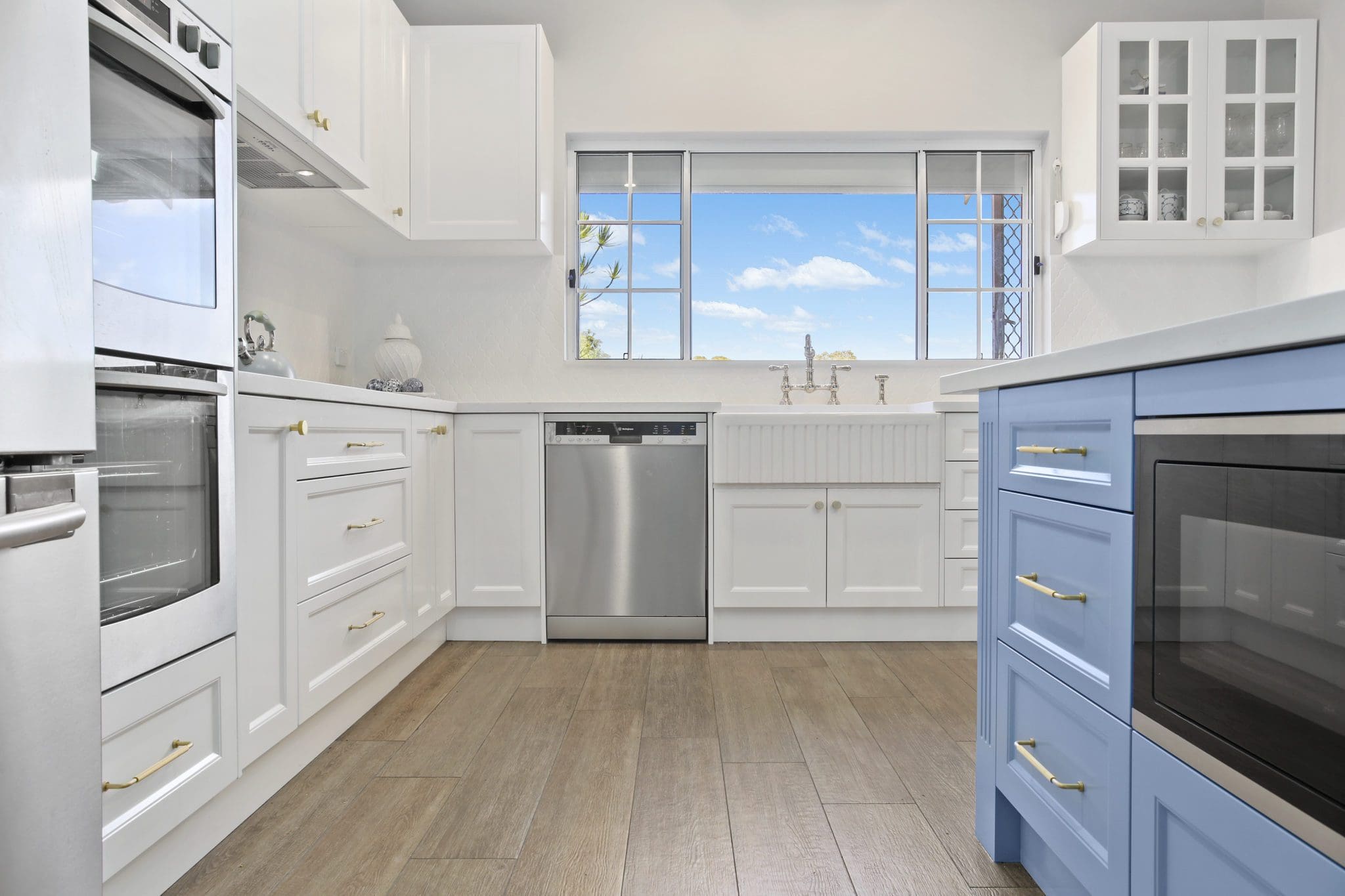
Shaker doors are flatter, with thinner rails and stiles. Crown moulding disappears. Hardware is streamlined: thin bar handles in matte black or brushed brass, or sometimes no handles at all (using a finger-pull or push-to-open mechanism). The colour palette can include darker tones: navy islands under white uppers, charcoal accents, or even olive green.
Benchtops are engineered stone with bolder veining, and splashbacks might be stone slab, large-format tile, or a clean panel instead of traditional subway tile.
Modern Hamptons is what happens when someone loves the warmth of Hamptons but wants a kitchen that feels current rather than nostalgic. It bridges the gap between Hamptons and modern minimalism.
Best Suited For
Newer homes with open-plan layouts and clean architectural lines. Homeowners who love the Hamptons palette and warmth but want something that feels contemporary. This is the fastest-growing Hamptons variant in the Macarthur region.
How to Decide Between Them
The right choice comes down to three things: your home, your lifestyle, and what you want to feel when you walk into your kitchen.
Look at Your Home’s Architecture
A traditional Hamptons kitchen in a 2015 project home with 2,400mm ceilings will feel forced. The proportions are wrong. Coastal or modern Hamptons will sit more naturally in these spaces because they rely less on vertical detail.
If you have a home with higher ceilings, wider doorways, or heritage features, traditional Hamptons has the room to breathe.
Think About How You Live
If your kitchen opens directly to a backyard, patio, or pool area, coastal Hamptons extends that indoor-outdoor connection. The relaxed palette and natural materials bridge the transition.
If your kitchen is the centrepiece of a formal entertaining space, traditional Hamptons gives you the gravitas that suits dinner parties and hosting.
If you want a kitchen that works for both Tuesday night spaghetti and Saturday night guests, modern Hamptons splits the difference well.
Consider Longevity
All three Hamptons styles have strong staying power compared to heavily trend-driven designs. But traditional Hamptons is the safest bet for resale value because it reads as “classic” to the widest audience. Coastal Hamptons is close behind. Modern Hamptons is current and appealing now, but because it borrows from contemporary trends, it may date slightly faster than the other two.
That said, “slightly faster” in this context still means a decade or more before it feels outdated. None of these are short-lived trends.
The Material Overlap
One of the nice things about the Hamptons family is that the core materials overlap. All three use stone benchtops, quality cabinetry (typically polyurethane for the best finish), and considered hardware.
The differences show up in the details: the door profile, the handle finish, the splashback choice, and the accent colours. These are decisions that an experienced designer can guide you through once you know which direction you are leaning.
See All Three Styles in One Place
If you are drawn to the Hamptons look but are not sure which version suits your home, the best next step is to see them in person. Our Narellan showroom displays cabinetry, stone, and hardware samples across all three styles.
You can also book a free in-home design consultation where Angela, our in-house interior designer, can assess your space and recommend which Hamptons style works best for your home, your layout, and your lifestyle.