Most kitchen renovations in the Macarthur region start with the same conversation. The homeowner wants new cabinetry, a stone benchtop, and a kitchen that looks nothing like the builder-grade one they have lived with for the past decade. That is all reasonable. But the conversation almost always skips the part that matters most: the layout.
New doors and a nice benchtop on a bad layout is like putting premium tyres on a car with a bent axle. It looks better, but it does not work better. And in a kitchen, how it works is everything.
Here is the layout mistake we see more than any other, why it happens, and how to avoid it.
The Mistake: Renovating Around the Existing Layout Without Questioning It
The most common error is not a design flaw. It is a thinking flaw. Homeowners assume the existing layout is fixed, so they renovate everything around it without asking whether the layout itself is the problem.
This happens for understandable reasons. Keeping the layout the same avoids moving plumbing and electrical, which saves money. It also feels simpler. The sink stays where it is. The cooktop stays where it is. You just replace what is on top.
But here is the issue. The layout in most Macarthur homes was designed by a volume builder to minimise cost, not to maximise function. The kitchen was laid out to keep plumbing runs short and to fit the space cheaply. It was not designed around how a family of four or five actually cooks, eats, and lives.
When you renovate around that layout, you inherit every problem it had on day one, just with nicer finishes.
Why the Builder-Grade Layout Fails
Homes across suburbs like Oran Park, Gregory Hills, Harrington Park, and Camden were built during Sydney’s south-west expansion. Many share similar floor plans from a handful of project home builders. The kitchens in these homes tend to have the same issues.
The Work Triangle Is Too Wide
The work triangle (the path between your fridge, sink, and cooktop) is the foundation of a functional kitchen. In many builder-grade kitchens, these three points are spread too far apart. You end up walking across the room every time you go from the fridge to the sink, or from the sink to the stove.
A well-planned kitchen keeps the work triangle tight without cramping. Each point should be within easy reach so cooking feels efficient, not exhausting.
The Island Is in the Wrong Spot
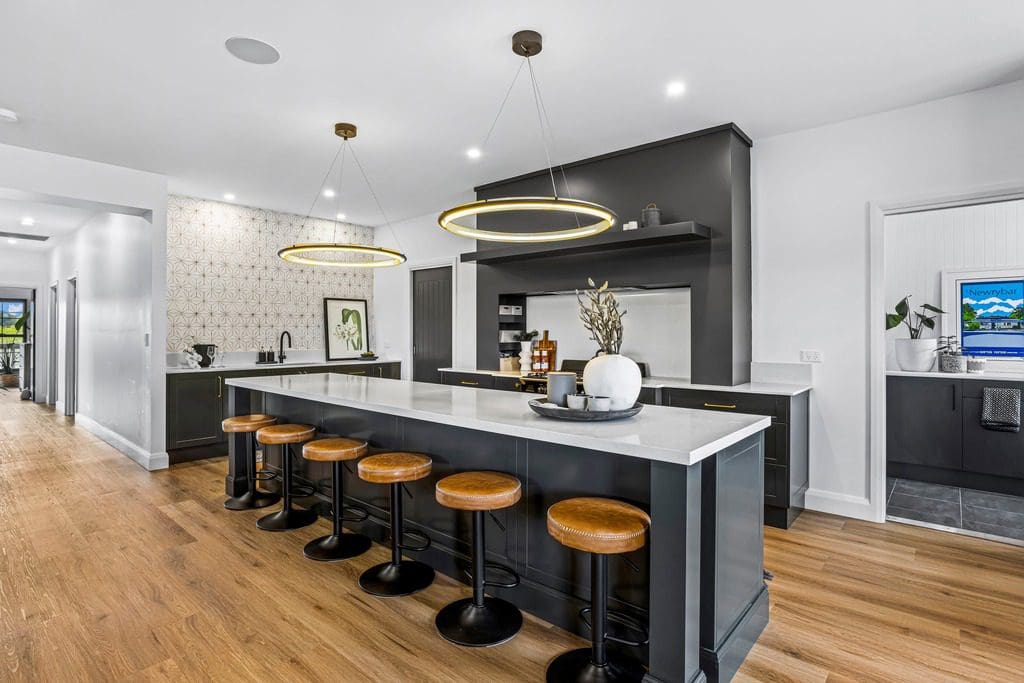
Some builder-grade kitchens include a small island bench that is too narrow to be useful and too close to the cabinetry behind it. You end up with a bench that blocks traffic flow, does not seat anyone comfortably, and creates a bottleneck between the kitchen and the living area.
An island should have at least 900mm of clearance on all sides (1,200mm is better if two people cook at the same time). If the space does not allow that, an island might not be the right choice for your kitchen, no matter how much you want one.
We wrote a separate piece on the benefits and pitfalls of kitchen islands that goes deeper on this.
The Pantry Is an Afterthought
In many original kitchens, the pantry is a single tall cabinet with fixed shelves. It holds a fraction of what a family needs, and everything at the back becomes invisible. Pull-out drawers, corner carousels, and dedicated pantry cabinetry solve this, but only if the layout gives the pantry enough space.
If you renovate the kitchen without rethinking the pantry position or size, you end up with the same storage problem in a prettier wrapper.
How to Think About Layout Before You Think About Finishes
The fix is a change in sequence. Before you choose door colours, benchtop materials, or handle styles, answer these questions about your layout.
Where Do You Actually Stand When You Cook?
Spend a week paying attention to your own movement in the kitchen. Where do you stand most? What do you reach for? How many steps do you take between the fridge and the chopping area? This tells you more about what needs to change than any floor plan.
Who Else Uses the Kitchen?
If your kids sit at the island to do homework while you cook, the island needs to face the right direction and have enough depth for books and plates at the same time. If two adults cook together, you need parallel workspaces, not a single run of benchtop where you bump elbows.
What Is the Traffic Flow?
In an open-plan home, the kitchen sits between the living area and the back door, the garage entry, or the laundry. People walk through the kitchen constantly. A good layout creates a clear path through the space without forcing anyone to walk between the cooktop and the person standing at the sink.
Can You Improve the Layout Without Moving Plumbing?
Sometimes yes. Repositioning the fridge, swapping the location of tall cabinetry, or changing the orientation of an island can dramatically improve how the kitchen works without touching a single pipe. A good designer will explore these options before recommending structural changes.
This is one of the reasons working with an in-house interior designer matters. They look at the layout as a system, not just a collection of surfaces to replace.
The Layout Comes First, Everything Else Follows
Once the layout is right, every other decision becomes easier. The benchtop size is determined by the bench run. The cabinetry configuration follows the storage needs. The splashback height fits the space between bench and overhead cabinets. The handle style matches the door profile.
But if the layout is wrong, nothing else compensates. You cannot style your way out of a kitchen where the fridge door blocks the pantry, or where the dishwasher opens into the island, or where the bin drawer sits on the wrong side of the sink.
A Layout Review Costs Nothing
If you are planning a kitchen renovation, the smartest thing you can do is have someone assess your layout before you commit to anything. Not just measure the room. Assess how the space flows, where the problems are, and what would change if you rethought the position of even one or two elements.
We offer a free in-home design consultation where layout is the first thing we look at. Not colours. Not materials. The layout. Because everything else depends on getting that right.
For more on how different layouts work, our guide to kitchen layouts covers galley, L-shaped, U-shaped, and island configurations in detail.